Western Regional Climate Center
July in the West
July, 2024
Summary
July was an exceptionally warm month for the West with record setting heat at many long-term climate stations. Monthly mean temperature records were broken but several all-time daily maximum temperature records were also set. It was also a dry month for much of the West and the combination of heat and limited moisture led to drought expansion in some regions; wildfire activity also saw a big uptick.
Temperature
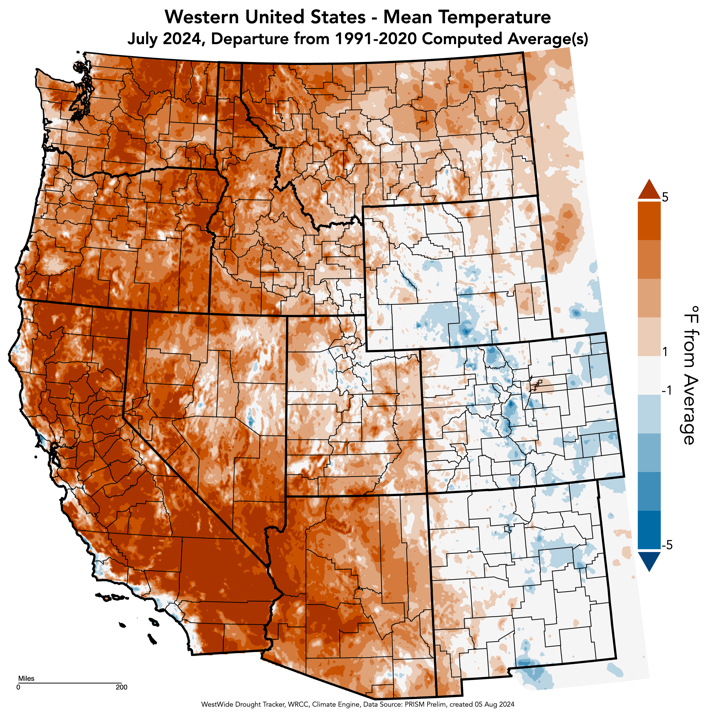
Most of the West experienced above normal temperatures in July with anomalies of +3 to +7 degrees Fahrenheit found throughout Arizona, California, Nevada, Oregon, Washington, and Idaho. Many new July mean temperature records were set at long-term climate stations in several states such Reno and Las Vegas in Nevada, Sacramento, Fresno, Bakersfield, and Death Valley in California, and Portland, Salem, Eugene, and Redmond in Oregon. Death Valley, California, recorded its warmest month in 102 years of records with a monthly mean temperature of 108.5 degrees Fahrenheit. Las Vegas, Nevada, broke several records including the hottest July at 99.9 degrees Fahrenheit and the all-time daily maximum temperature of 120 degrees Fahrenheit which occurred on July 7; remarkably the previous all-time high was 117 degrees Fahrenheit and this July 118 degrees Fahrenheit occurred twice (July 10 and 11) and 119 occurred once (July 9). Parts of central and eastern New Mexico were spared the heat and saw near-to-slightly-below-normal temperatures.
Precipitation
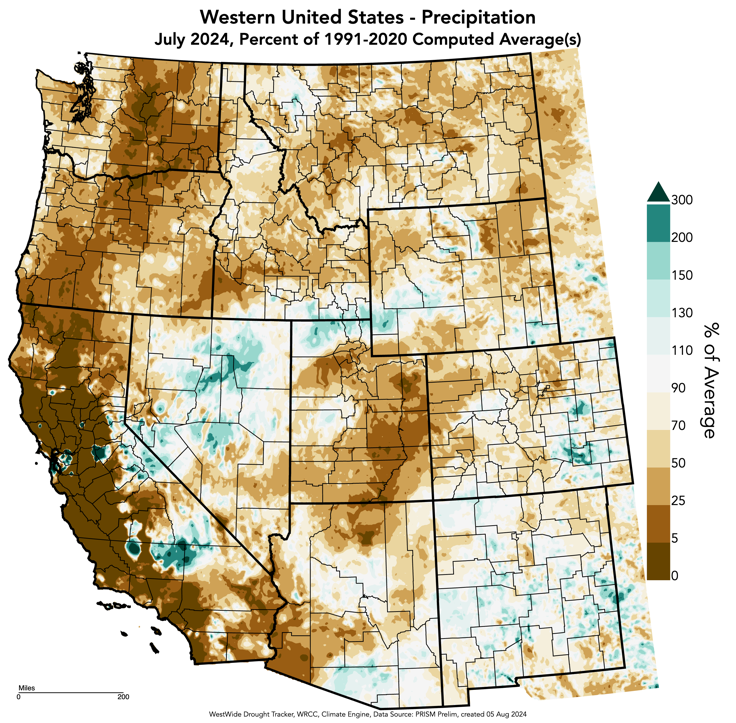
Below-normal precipitation occurred for much of the West except for some isolated areas in the Great Basin and parts of Arizona and New Mexico. Climatologically, July is one of the driest months in West except for the core monsoon states of Arizona and New Mexico. Most of Arizona saw below normal precipitation with some parts receiving less than 50 percent of normal; isolated parts of the state were above normal. Bright Angel Ranger Station in the Grand Canyon, Arizona, received 0.30 inches of precipitation (17 percent of normal) and was the fourth driest on record. Much of New Mexico saw above normal precipitation with some locations more than 200 percent of normal. Grand Quivira National Monument had its second wettest July with 6.12 inches of precipitation (217 percent of normal) and Portales received 5.14 inches (224 percent of normal). Southwest Montana was notably dry with monthly departures of more than one inch for some locations. Butte, Montana, had its eighth driest July with just 0.19 inches of precipitation (16 percent of normal).
Drought
According to the U.S. Drought Monitor (USDM) at the end of July, 29 percent of the West was in drought. Areas of extreme (D3) drought are found in southern New Mexico with D3 and exceptional drought (D4) in western Montana. Spatially, the greatest drought expansion occurred in Oregon with most of the state now in abnormally dry (D0) or moderate drought (D1). Monsoon rains have helped to reduce some of the spatial extent and severity of drought in New Mexico.
Alaska Summary
Alaska saw below-normal temperatures in most of the state with anomalies generally -1 to -4 degrees Fahrenheit. The Panhandle saw near-to-slightly-above-normal temperatures. Mean monthly temperature anomalies were -1.3 degrees Fahrenheit at Anchorage, -1.6 degrees Fahrenheit at Fairbanks, and -4.3 degrees Fahrenheit at Kotzebue. It was a wet month for most of Alaska with several long-term stations in the top ten wettest Julys. In the Panhandle, Juneau had its wettest July on record with 12.21 inches of precipitation (238 percent of normal) and Sitka saw the third wettest July with 9.56 inches (207 percent of normal). Nome recorded 6.16 inches of precipitation (262 percent of normal), Anchorage received 4.03 inches (221 percent of normal), and Fairbank saw 4.18 inches (185 percent).
Hawaii Summary
Below-normal precipitation occurred throughout Hawaii with many stations reporting less than 50 percent of normal. Honolulu tied the record for driest July (also occurred in 2017) with 0.02 inches of precipitation (4 percent of normal) and Lihue also saw its driest July with 0.64 inches of precipitation (37 percent of normal). Hilo had its tenth driest July with 4.84 inches of precipitation (52 percent of normal). Dryness led to increased extent of drought by the end of July with 55 percent of the state in drought. Severe drought (D2) was found only on the Big Island and Molokai with no D3 or D4 present in the state.
Significant Events for July 2024
Death Valley observed hottest month ever: The Furnace Creek Visitors Center in Death Valley, California, recorded a monthly mean temperature of 108.5 degrees Fahrenheit, making it the hottest month in the stations record that dates back to 1911. Nine days in July had a maximum temperature of 125 degrees Fahrenheit of higher which is the second hightest on record (1913 had ten days above this threshold). The National Park Service reported numerous heat related illness and injury cases including a man who had to be rescued after losing his flip flops and receiving second degree burns on his feet.
July 2024 Departure from Normal Temperature and Percent of Normal Precipitation for Western United States